Commercial Parking Lot Concrete Repair That Lasts
> Commercial parking lot repairs and fixes trip hazards, drainage failures, and broken slabs with durable base work, reinforcement, joints, and pricing.
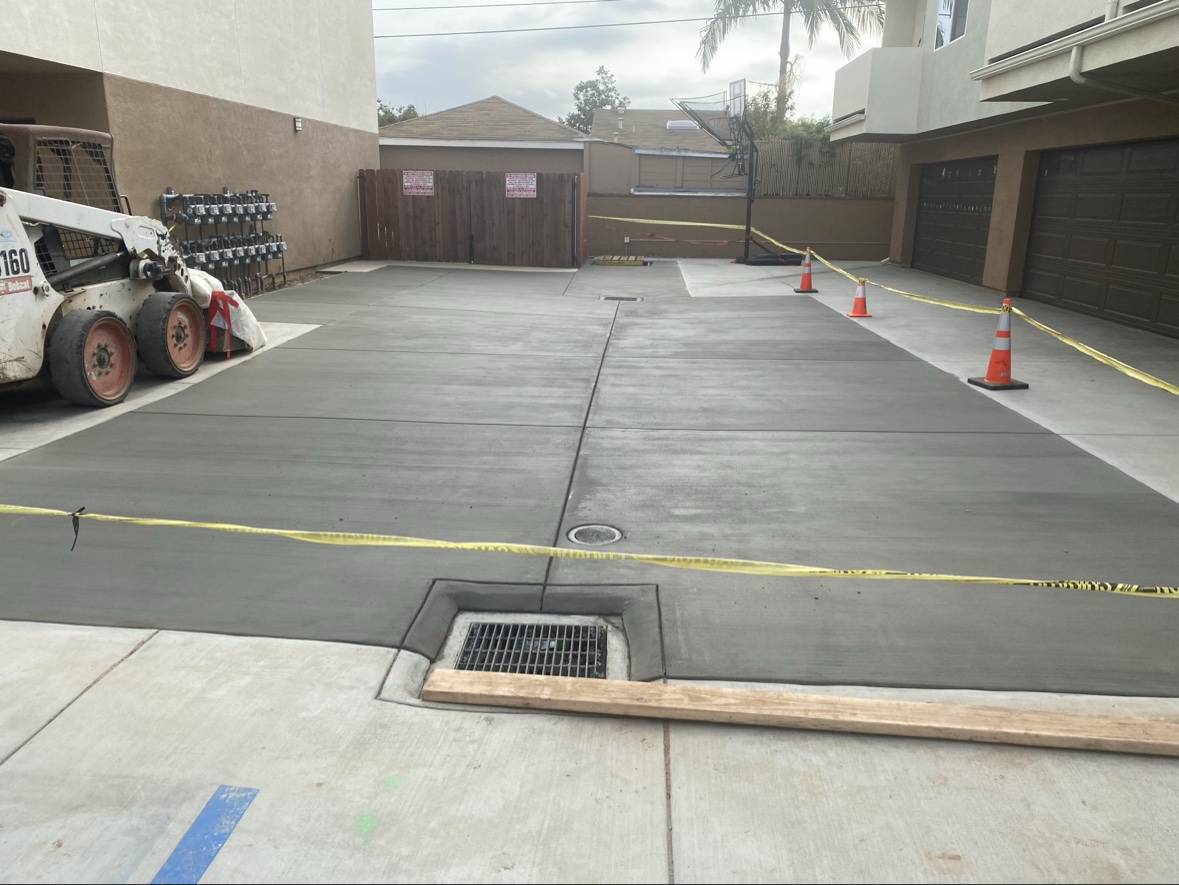
A parking lot can look acceptable from a moving car while creating real liability at walking speed. A lifted slab at a storefront entrance, a pothole near a loading area, or standing water in an accessible route can lead to vehicle damage, trip hazards, tenant complaints, and lawsuits . Commercial parking lot concrete repair needs to address those problems not simply cover them with patch material.
For property owners and facility managers, the right repair begins with a direct question: is it time to patch, remove and repair or full overhaul? In Southern California, heavy vehicle loads, poor drainage, weak base material, tree roots, settlement, and undersized slabs all leave different clues. The repair method should match the cause, traffic level, and condition of the surrounding pavement.
Start With the Assessment
A thorough site assessment comes first. Before anything else, check whether the site is handicap compliant — because once you touch it, you need a plan, and the city approval before you start. If they stop you mid-job, they're going to ask for a new site plan. So get it done beforehand.
What can come into question is whether you're doing improvements or changing the occupancy — either one can trigger a review. And one thing the review will require is the water math: how much water the site collects, how you're getting it out, and what the system needs. The assessment means having an engineer design the new site plan to the regulations. After the plans are done and have passed, then the work can start.
Reading the Slope
A thorough site assessment starts with the slope and how the lot was built. Wrong slopes mean water sits, and sitting water is what kills a lot. On big, long lots the slopes get very tight, so the drainage has to be right. Re-pouring a lot without fixing the water flow just buys the same failure again in a few years.
The assessment also takes in downspouts and drains, vehicle paths, curb lines, tree roots, prior repairs, and the condition of adjacent slabs. Replacing one broken panel without correcting the water flow that killed it leaves the new concrete in the same position a few years later.
This matters especially at retail centers, multifamily properties, office buildings, medical offices, warehouses, and restaurant sites. Passenger cars, delivery vans, trash trucks, and fire access vehicles do not place the same load on a slab. A section that works at a pedestrian walkway may not hold up in a dumpster enclosure or loading lane.
Drainage: V-Gutters and Catch Basins
The way water gets out is usually through a V-gutter — a rebarred concrete channel, graded at about a 0.5% slope, that collects the water and carries it away. Directed water in a gutter moves far faster than swale flow across flat pavement, which is why the gutter is the most important piece of the drainage: it carries the water away, and water must not stagnate in it. Water stagnation introduces early failure and more cost, and it adds up.
The review may require collection or treatment systems depending on the lot and the city requirements. If no treatment is required, it's catch basin to piped drainage out. Figure the length of the lot and the elevation so everything feeds into the gutter slowly — water arriving slowly, not ponding, not sinking in. The whole lot grades into it. The longer the lot, the harder this gets, because the water has farther to travel. You can also implement a pipe drainage system and pump if need be. This will all be designed by your engineer to a T.
Any area lower than the surrounding elevation — like a dock — needs a big, deep catch basin with two pumps, calculated into the plans: pump one runs, pump two fires if the first can't keep up. That means electrical, a panel with an alarm, and floaters.
If the lot doesn't have a V-gutter, one usually has to go in as part of the repair.
Warehouse Docks
The dock is all concrete. Determine the height so trucks back into the dock levelers right, and the dock run is usually about 40 feet long with a set slope and a trench drain running its full length, emptying out into a catch basin and the sump pump.
Asphalt vs. Concrete: The Honest Math
For a big commercial lot, asphalt is the better route. It holds up — though with big rig trucks there's more maintenance, and it works and in the long run will save you money. But when concrete deteriorates, the fixes cost far more than asphalt maintenance ever will. Asphalt needs less material and the material itself costs less.
Here's the kicker: four inches of asphalt on a base does it for a fraction. That's why concrete isn't the recommendation for commercial parking — except in residential plaza parking, where the vehicle weight is far less.
Fire Access Shapes the Layout
Fire trucks need a path in and a way to turn around, and that's a regulation, not a suggestion. The aisles have to be sized so a fire apparatus can get through — under the California Fire Code that's a minimum 20-foot unobstructed width (26 feet where hydrants are present). Any dead-end access road over 150 feet needs an approved turnaround — in LA County, figure 25 feet for the turnaround itself (a 96-foot cul-de-sac or a hammerhead are the typical forms). The fire department's plan review checks turning radii on the site plan and hydrant locations — typically about one hydrant every 250 feet on site. There can be additional local requirements on top of the state code, so this is another reason the design goes through the city and the fire department before anything is poured — and another reason to know where the nearest fire hydrant is.
The Concrete Elements: Curbs, Gutters, Sidewalks
The asphalt, the striping, and the sealcoating are one aspect of the maintenance, but the concrete parts will need to be reviewed too. The concrete is the part mostly overlooked — and it's the part that frames the whole lot: curbs, gutters, sidewalks, and the drainage structures.
ADA: Ramps, Stalls, Signs, and Truncated Domes
Here's where concrete earns its place in a commercial lot. The accessible parking stalls are recommended to be concrete, because holding a true 2% slope is easier with concrete. Asphalt settles and ruts; concrete holds the grade. Same story for sidewalks, ramps, and stairs.
- Ramps: no steeper than 8.33% (1 foot of rise per 12 feet of run), with no more than 2% side slope. On long runs they zig-zag with landings. Groove marking at the top, truncated domes at the bottom of the ramp if leading to the street.
- Sidewalks: 2% max cross slope, 5% max going up.
- Landings: anywhere before a ramp or a change of direction, 2% max in every direction. Every exterior door gets a 4-foot landing — and if a door sits at the end of a ramp, that landing needs to be 6 feet.
- Accessible parking: 2% max slope in all directions, including the access aisle. The aisle is 5 feet for a standard accessible stall, 8 feet for van.
- How many accessible stalls the code requires (per parking facility, 2010 ADA Standards Table 208.2): 1–25 total stalls → 1 accessible; 26–50 → 2; 51–75 → 3; 76–100 → 4; 101–150 → 5; 151–200 → 6; 201–300 → 7; 301–400 → 8; 401–500 → 9; 501–1,000 → 2% of total; over 1,000 → 20 plus 1 for each 100 over 1,000. At least one of every six accessible stalls (or fraction) must be van-accessible. California's building code layers additional detailing on top of these federal minimums.
Parking Layout: Stalls, Signs, and EV
The parking layout is part of the design: stalls for the whole building, signs, handicap, and EV parking — including future EV, which is now regulated. Building ADA compliance upgrades ride along with it.
Trash Enclosures: Concrete and Block
Trash enclosures are concrete and block — same crew, same pour logic, no finger-pointing between trades.
When Commercial Parking Lot Concrete Repair Is the Right Call
Full parking lot replacement is not always necessary. /concrete_repair.html can be the practical choice when failure is limited to defined panels and the surrounding lot remains structurally sound. Common repair areas include damaged parking stalls, drive lanes, curbs, sidewalks, wheel-stop areas, loading zones, dumpster pads, catch-basin approaches, and accessible parking routes.
A remove-and-replace repair is usually the better long-term option when concrete has settled, heaved, spalled deeply, broken into multiple pieces, or developed a significant height difference. The damaged slab is saw-cut at clean boundaries, removed, and rebuilt from the subgrade up. This creates a defined repair area that can be properly prepared, reinforced, graded, and jointed.
Surface patching has a place, but it has limits. Small shallow spalls and localized edge damage may accept a properly prepared repair mortar. Patching a slab that is moving, saturated underneath, or failing across its thickness is usually a temporary answer. It may improve appearance for a short time, but the underlying movement will continue.
Concrete grinding can help reduce a minor trip hazard where the slab itself is stable and the elevation difference is limited. It is not a substitute for replacement when settlement is substantial, drainage is poor, or the concrete has lost structural integrity. The right choice depends on the site condition, not on which repair sounds fastest.
What a Durable Concrete Repair Includes
The visible concrete is only one part of the work. A commercial repair should be built in layers, with each layer supporting the next.
Removal and base preparation
The failed concrete must be removed without damaging sound adjoining panels. Once the slab is out, the base can be inspected for soft spots, washed-out material, roots, voids, or evidence of poor compaction. Weak material should be removed and replaced with properly compacted base before new concrete is placed.
Base preparation is where many short-lived repairs go wrong. Fresh concrete poured over loose soil or an uneven base may look clean on day one, then settle under traffic and water. Proper compaction gives the slab uniform support and reduces the chance of future movement.
Correct thickness and reinforcement
Concrete thickness should reflect how the area is used. A pedestrian sidewalk and a drive lane serving delivery vehicles should not automatically receive the same design. Heavier traffic areas may need thicker concrete and more substantial preparation than standard parking stalls.
/does-a-concrete-driveway-need-reinforcement.html helps hold the slab together if cracking occurs and improves performance where traffic loads are higher. It must be placed at the proper height within the slab, not left sitting on the base. Reinforcement does not fix bad soil or poor drainage, but it is an important part of a durable commercial concrete section when paired with correct base work.
Drainage grading and control joints
Water is one of the fastest ways to shorten concrete life. Standing water can soften subgrade, carry fines out from below slabs, create slippery conditions, and accelerate deterioration at joints. Every repair should be graded to direct water toward the intended drainage path without creating a new low spot at the repair boundary.
Control joints guide concrete shrinkage cracking into planned lines. Joint layout should work with the size and shape of the replacement area, existing joints, traffic paths, and nearby structures. Random cracks often show up when joints are missing, too far apart, or cut too late.
Maintenance: Safety First, Water Second, Cosmetics Last
Walk the lot on a schedule. Fix safety hazards first — potholes in drive lanes, trip hazards, broken lighting. Water pathways second — cracks, failed joints, clogged basins, anything holding water. Surface work and cosmetics last. Spending money on surface work while the drainage is failing is like painting a house with a leaking roof — fix the water first. Measure before you bid: area in square feet, crack length in linear feet, stall counts. Repairs are scoping, not vibes.
Plan Repairs Around Business Operations
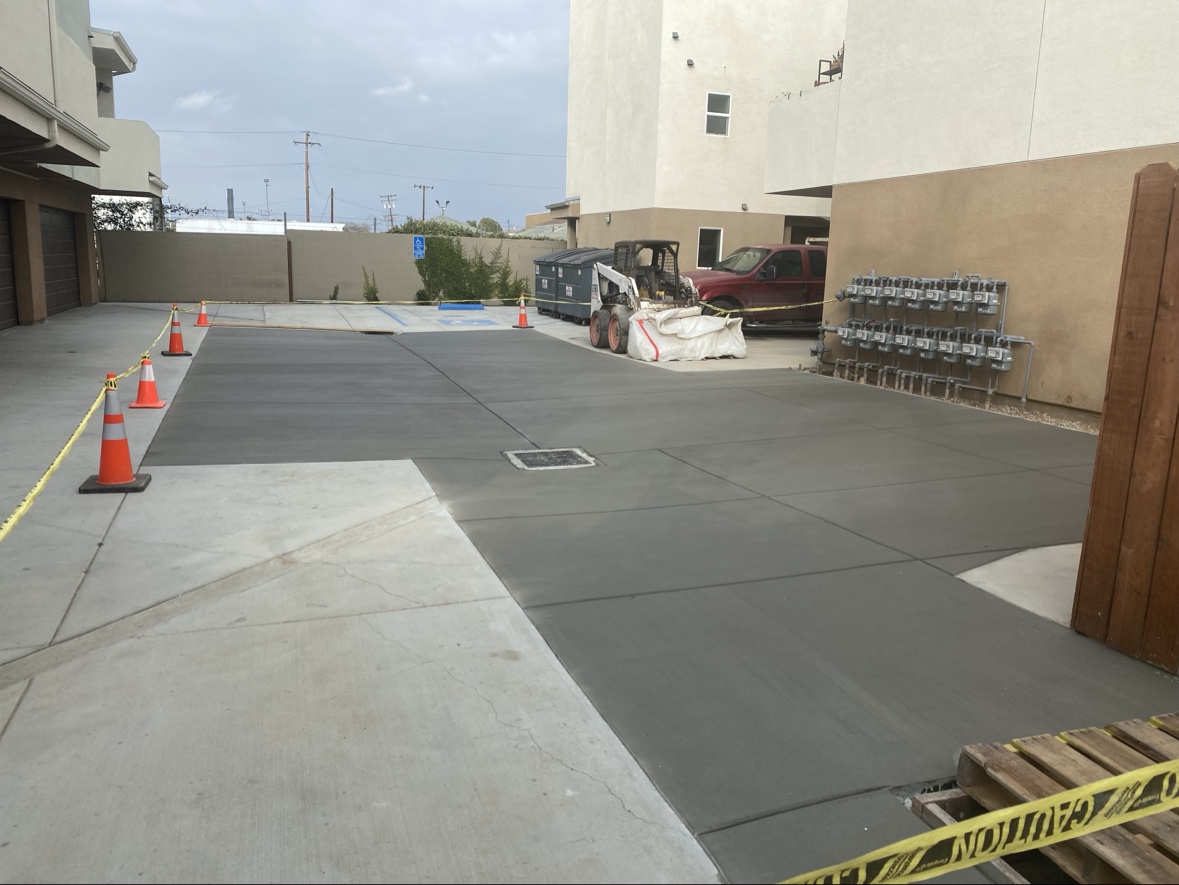
Commercial concrete work affects traffic flow, parking availability, deliveries, and customer access. The best repair plan is not always the largest pour. In many cases, phasing the work keeps a property functional while damaged sections are removed and replaced.
Before work begins, identify delivery windows, tenant peak hours, emergency access requirements, trash pickup schedules, and areas that must remain open. Barricades and clear routing are part of a professional job, particularly where pedestrians and vehicles share the same site.
Concrete also needs time before it can handle traffic. Foot traffic may be possible sooner than vehicle traffic, but the schedule depends on the mix, weather, slab design, and the type of loads expected. Rushing cars or trucks onto /protect-fresh-concrete.html can damage edges and reduce the value of the repair before it has had time to cure.
Questions to Ask Before Approving a Repair
A firm proposal should explain what is being removed, how deep the repair will go, what base work is included, the planned concrete thickness, reinforcement details, drainage approach, and how joints will be handled. It should also clarify whether hauling, traffic control, striping coordination, and accessibility work are included or separate.
Be cautious with a price based only on square footage and a quick visual look. Two repair areas with the same dimensions can require very different work depending on demolition depth, soil conditions, drainage corrections, access, reinforcement, and traffic demands. A clear on-site assessment gives everyone a better starting point than a low number that grows once the work is underway.
For properties in Covina, the San Gabriel Valley, northern Orange County, and the Inland Empire, J. Ortega Concrete approaches commercial work with the same construction-first standard used on every slab: proper base preparation, reinforcement where it belongs, joints that make sense, and grading that drains. The goal is not to make a failed section look covered up. It is to rebuild it for the traffic and water conditions it will actually face.
A damaged parking area rarely improves on its own. Addressing it while the failure is limited can protect access, reduce liability, and keep a manageable repair from turning into a larger replacement project. Start with the cause, insist on clear scope and firm measurements, and build the repair thick, reinforced, and graded to drain.
Dealing with a failing parking lot? Call J. Ortega Concrete at (626) 404-8582 for a free estimate.
Call (626) 404-8582 for a Free Estimate
Related Services
- Concrete repair — crack repair and panel replacement
- Parking lot paving — new lots and overlays
- Protecting fresh concrete — curing and early traffic