How Thick Should a Concrete Driveway Be for Lasting Use?
A driveway that looks good on pour day can still crack, settle, or break at the edges within a few years if it was poured too thin for the traffic and soil beneath it. So, how thick should a concrete driveway be? For most homes with passenger vehicles, 4 inches is the standard. But a driveway built for long-term performance is not always a thicker driveway — often it is the same 4-inch slab with tighter rebar, the right PSI, and the base, joints, and drainage built right.
The right thickness depends on what will drive over it, the condition of the subgrade, the quality of the compacted base, drainage, reinforcement, and how the slab is jointed. Concrete is strong in compression, but it is not forgiving when the ground below moves or water washes out support. The goal is not simply a thicker slab. It is a driveway built right: the right rebar, the right PSI, and graded to drain.
How Thick Should a Concrete Driveway Be?
For standard cars, SUVs, and light pickup trucks, a 4-inch concrete driveway is the complete job — and it is our standard build: a 4-inch slab of 3000 PSI concrete with #3 rebar at 18 inches on center. That assumes stable native soil, sound drainage, and normal residential traffic.
When a bigger truck will use the driveway, our first move is not a thicker slab — it is tighter rebar. The same 4-inch slab with #3 rebar at 12 inches on center, or even 8 inches on center, is plenty strong for a trash truck and very commercial loads. The reason for tighter rebar is that it is cheaper. The math is simple: a typical 400-square-foot slab takes about 33 rebars at standard spacing. Put them in tighter and you are at about 40 — just a few more bars, and you have accomplished a lot more. Another inch of concrete on that same slab is 400 square feet at $2.50 a foot — $1,000 — where a few extra bars cost a fraction of that.
We run #3 rebar, not #4, for a reason. Tighter #3 matches the strength of #4 at 16 inches on center — and because #3 is a thinner bar, it leaves a little more concrete cover over it. That cover matters: rebar left too high in a slab weathers, and within about 10 years it produces cracks on the top. The higher it is left, the sooner it shows. We see it a lot with #4 left high.
A 5-inch slab is reserved for the client who wants a thicker slab. We do not oppose it — once a person is set on a certain feature, it is hard to convince them otherwise, and they would have to go back and do research. But if we are doing it our way, we put more rebar instead, and the slab is stronger. A 5-inch slab with #4 rebar at 16 inches on center is still plenty strong for a big truck or an RV, and it will support that weight — it is just not the way we would build it first.
A 6-inch slab with #4 rebar at 6 inches on center is what handles a semi — we do that in parking lots. But 6 inches is not cost-effective unless a very heavy truck is actually going to use it. For a home driveway, it is more concrete than the job needs.
There is one more way to handle heavy loads without thickening the whole slab: thickened edges. Pressure starts at the edges — that is where vehicles roll on and off, where the slab meets the street, the apron, and the garage. A truck getting onto the driveway hits the edge first, so that is the first place the stress lands. So instead of pouring the entire driveway thicker, you thicken just the edges: roughly an 8-inch edge, the slab's 4 inches plus another 4 inches straight down below it, so at the edge the concrete is 8 inches thick. The thickened edge takes the pressure, and the rest of the slab is no longer the pressure point. It is a little bit of extra concrete, but it does wonders on that edge when the stress is applied. It costs more to build — the extra excavation and concrete are added into the price — but it is a targeted fix: heavy duty where the load actually hits, standard slab everywhere else.
For reference, the specs you will usually see on paper are a 4-inch slab with #4 rebar at 16 inches on center on residential projects, and a 6-inch slab with #4 rebar at 16 inches on center on commercial projects. Those are the engineer's calculations, and when a job has an engineered spec, we follow it. But if you want to save money, tighter #3 is the option. Most people go with the thicker slab to get more strength — and you are going to pay for it.
Two special cases: at the beach, we do not put rebar — we put fiber mesh, which is also strong. And where the work is structural, you use epoxy rebar.
PSI matters too, and it matters a lot for how long a driveway lasts. When we demo regular concrete, it comes out fast. Concrete poured at 4000 PSI is so hard and so tightly packed together that it is very, very hard to break. Where there is a lot of movement, bigger PSI helps. And the rebar gets tied in, so the mat does not separate.
On our estimates, if you do choose a thicker slab, the price is simple: each additional inch of slab thickness adds $2.50 per square foot.
Thickness should be consistent across the slab. A driveway that is called 4 inches but has thin areas from poor excavation or an uneven base is not a true 4-inch driveway. Thin spots become weak spots, especially near edges, low areas, and garage approaches.
Driveway Thickness by Use
There is no one combination that fits every property, but this ladder is a dependable starting point — and notice that the first step up is tighter rebar, not a thicker slab:
- 4 inches, #3 rebar at 18 inches on center: Typical passenger cars, crossovers, and light residential use. Our standard build.
- 4 inches, #3 rebar at 12 inches on center (or 8 inches): Bigger trucks, trash trucks, and very commercial loads — tighter rebar instead of a thicker slab, and cheaper than an extra inch of concrete.
- 5 inches, #4 rebar at 16 inches on center: Big trucks and RVs — for the client who wants a thicker slab.
- 4 inches with thickened edges (8 inches at the edge): Heavy loads at entry points — the edge takes the pressure so the rest of the slab is not the pressure point; costs more, added into the price.
- 6 inches, #4 rebar at 6 inches on center: Semis and parking lots. Not cost-effective for a home driveway unless a very heavy truck uses it.
- Fiber mesh instead of rebar: Beach work.
- Epoxy rebar: Structural work.
The garage apron, street approach, and areas where vehicles turn or brake deserve special attention. Those locations take more stress than a straight section of driveway, so they get a thicker edge, a thickened approach, or additional reinforcement — the site decides which.
Thickness Alone Will Not Prevent Cracking
Concrete naturally shrinks as it cures. It can also move when soil expands, dries out, settles, or loses support from water. Some cracking is normal in concrete work. What separates a durable driveway from a short-lived one is whether the installation controls where cracking occurs and prevents the slab from moving independently.
Start With Proper Base Preparation
The subgrade is the soil under the driveway. It must be shaped, moisture-conditioned when needed, and compacted so the slab has uniform support. Soft pockets, loose fill, roots, organic material, and poorly compacted soil should be addressed before concrete arrives.
On stable ground, a well-compacted native subgrade carries a standard driveway. Where the soil needs more support, we add a compacted crushed rock base — priced on our estimates at $3.50 per square foot, which covers 4 additional inches of dirt removal and 4 inches of crushed rock. The base improves support, promotes more even drainage, and creates a more consistent surface for the concrete.
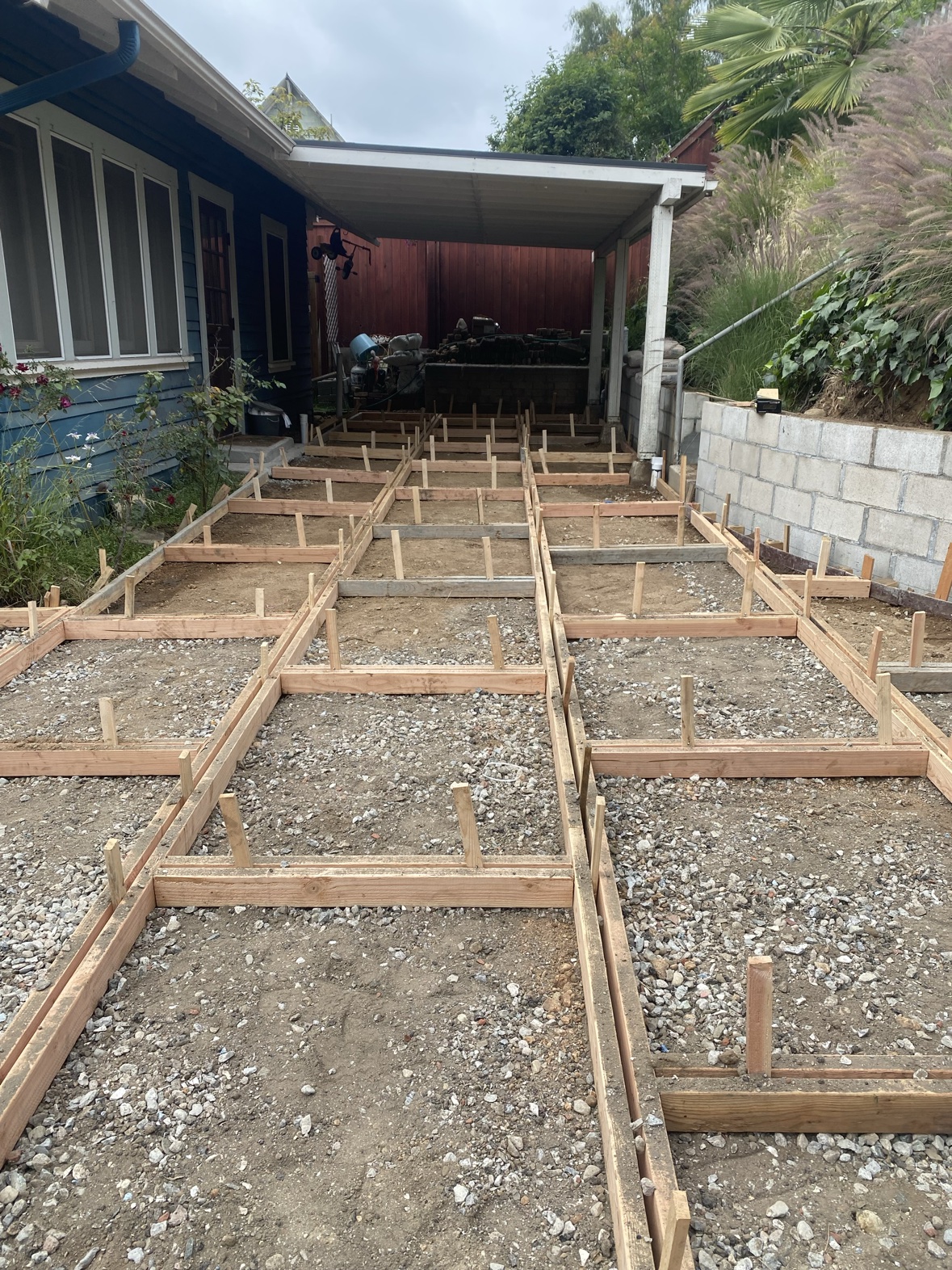
On expansive soil, that 4-inch gravel layer does a second job: it acts as a buffer between the soil and the slab, so when the soil swells and shrinks with moisture, the movement is softened before it reaches the concrete. It is the practical first line of defense — but the best solution for expansive ground is a soil engineer's recommendations for your specific soil, and on expansive-soil properties that is what we build to.
Pouring 5 inches of concrete over weak, wet, or uncompacted ground does not fix the cause. The slab can still crack and sink because the support underneath failed.
Trees Near the Driveway
Tree roots are the other force working under a slab. Roots grow toward the moisture that collects beneath concrete, thicken year after year, and lift the slab from below — the raised, cracked panel next to a street tree is the classic result. On a replacement job with trees nearby, the roots in the excavation come out before anything is poured, and a root barrier goes into the graded soil before the pour — we use the BioBarrier root control system, which releases a root-growth inhibitor in the soil zone under the slab so roots don't re-establish there, without harming the tree. The problem gets addressed, not buried for the next owner.
Reinforcement Must Be Placed Correctly
Rebar helps hold a slab together if a crack develops. It does not turn poor base work into a durable driveway, and it does not eliminate control joints. It is part of a complete system — which is why our standard driveway is reinforced with #3 rebar at 18 inches on center, not left unreinforced.
The placement matters. Reinforcement lying on the bottom of the excavation provides far less benefit than reinforcement supported within the slab where it can work as intended.
A good installer will also pay attention to transitions. The joint where a driveway meets a garage slab, sidewalk, curb, or existing concrete needs to allow for movement while maintaining a clean, durable connection.
That is also where expansion felt goes — and on a driveway, we usually put it at the ends: right after the apron, and right in front of the garage. The felt sits between the two pieces of concrete as a separation — almost like a little sponge in between. Vehicular traffic goes in and out all day, and the slab expands and contracts with temperature, so the felt absorbs that movement and there is no pressure between the pieces. When the two pieces move or separate, the separation forms in the felt instead of the concrete, and the pieces never hit each other. That is what keeps the edges from spalling — the chipping and flaking you see when two slabs grind against each other.
Control Joints Direct the Cracks
Control joints create planned weak planes so shrinkage cracks occur in straighter, less noticeable locations. Without a sound joint layout, concrete will choose its own path — usually across the most visible part of the driveway.
As a rule, joint depth should be at least one-quarter of the slab thickness. A 4-inch slab needs joints cut or tooled about 1 inch deep; a 5-inch slab needs roughly 1 1/4 inches. Joint spacing and panel shape matter too. Long, narrow, or irregular panels are more likely to crack unpredictably than square or nearly square panels.
Drainage Is Part of the Structural Work
Water is one of the biggest threats to driveway performance. If water runs beneath the slab, stands at the garage, drains toward the home, or saturates the soil beside the driveway, it can create settlement and cracking problems that no amount of surface patching will solve.
A driveway should be graded to move water away from structures and toward an appropriate drainage route. The right slope varies with the site, but it must be enough to shed water without creating an awkward entry, a trip condition, or runoff toward a neighbor's property. Drainage is one of our specialties: most concrete contractors don't do drainage work, and most drainage contractors don't pour concrete — we do both, with one crew.
Drainage evaluation is especially important when replacing an old driveway. Cracks, low spots, and standing water are useful clues. They may point to poor slope, a failed base, runoff from a roof downspout, leaking irrigation, or soil movement. Replacing concrete without correcting those issues can repeat the same failure pattern.
What About Decorative Driveways?
Stamped, colored, stained, and exposed-aggregate driveways still need the same structural foundation as a plain broom-finish driveway. Decorative work changes the appearance of the surface. It does not reduce the need for adequate thickness, reinforcement, base preparation, joints, and drainage.
In fact, planning matters even more with decorative concrete because uncontrolled cracks can be more visible in a patterned or colored finish. A clean joint layout should be considered before the pour so it works with the driveway's pattern, borders, and overall curb appeal.
Questions to Ask Before Approving a Driveway Quote
A low price can hide missing structural work. Before choosing a contractor, ask what slab thickness is included, how the existing driveway will be removed, how deep the excavation will be, and what will be done with unsuitable soil. Confirm whether crushed rock base, rebar reinforcement, control joints, expansion material, and drainage grading are included — and get the price of an extra inch of thickness in writing (ours is $2.50 per square foot).
Also ask how thickness will be maintained at the edges and whether areas used by trucks, trailers, or frequent deliveries need additional depth. Firm answers are better than vague promises. The scope should state what is being built, not just the square footage being poured.
For homeowners in Covina, the San Gabriel Valley, northern Orange County, and the Inland Empire, J. Ortega Concrete evaluates the driveway as a full construction system — traffic, soil support, reinforcement, joints, and drainage — before providing a firm project price.
A driveway should be sized for the vehicles and conditions you actually have, not the minimum that looks acceptable on paper. Before replacing yours, take stock of heavier vehicles, drainage problems, and any history of settling. Those details are what turn a new slab into a driveway built for decades.
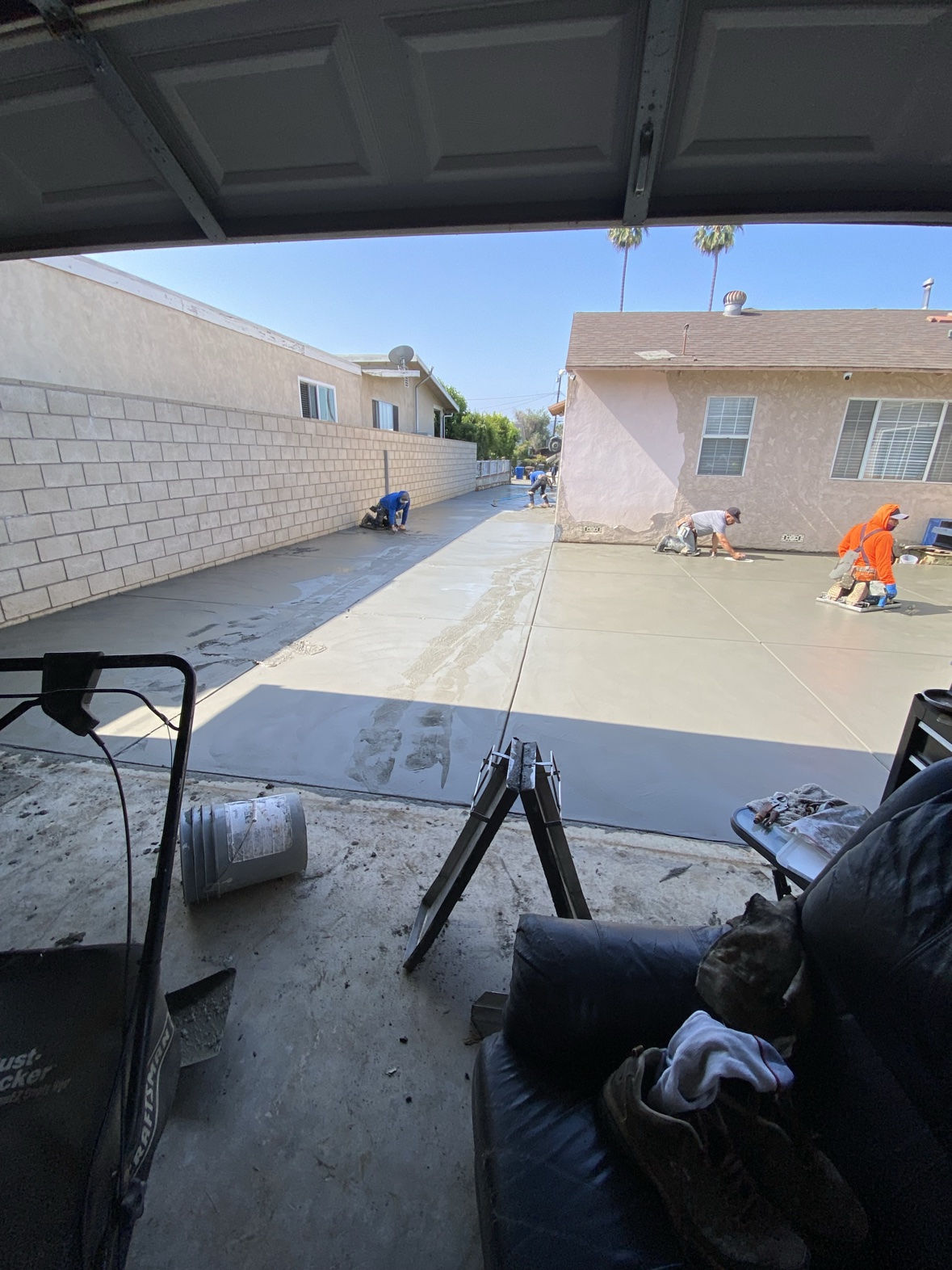
Thinking about a new driveway? Call J. Ortega Concrete at (626) 404-8582 for a free estimate.
Call (626) 404-8582 for a Free Estimate
Related Services
- Driveway installation — new driveways, tear-out and replacement
- Cost of concrete driveway installation — what drives driveway pricing
- Does a concrete driveway need reinforcement? — rebar, mesh, and what actually holds a slab together
- Concrete repair — crack repair, leveling, and resurfacing